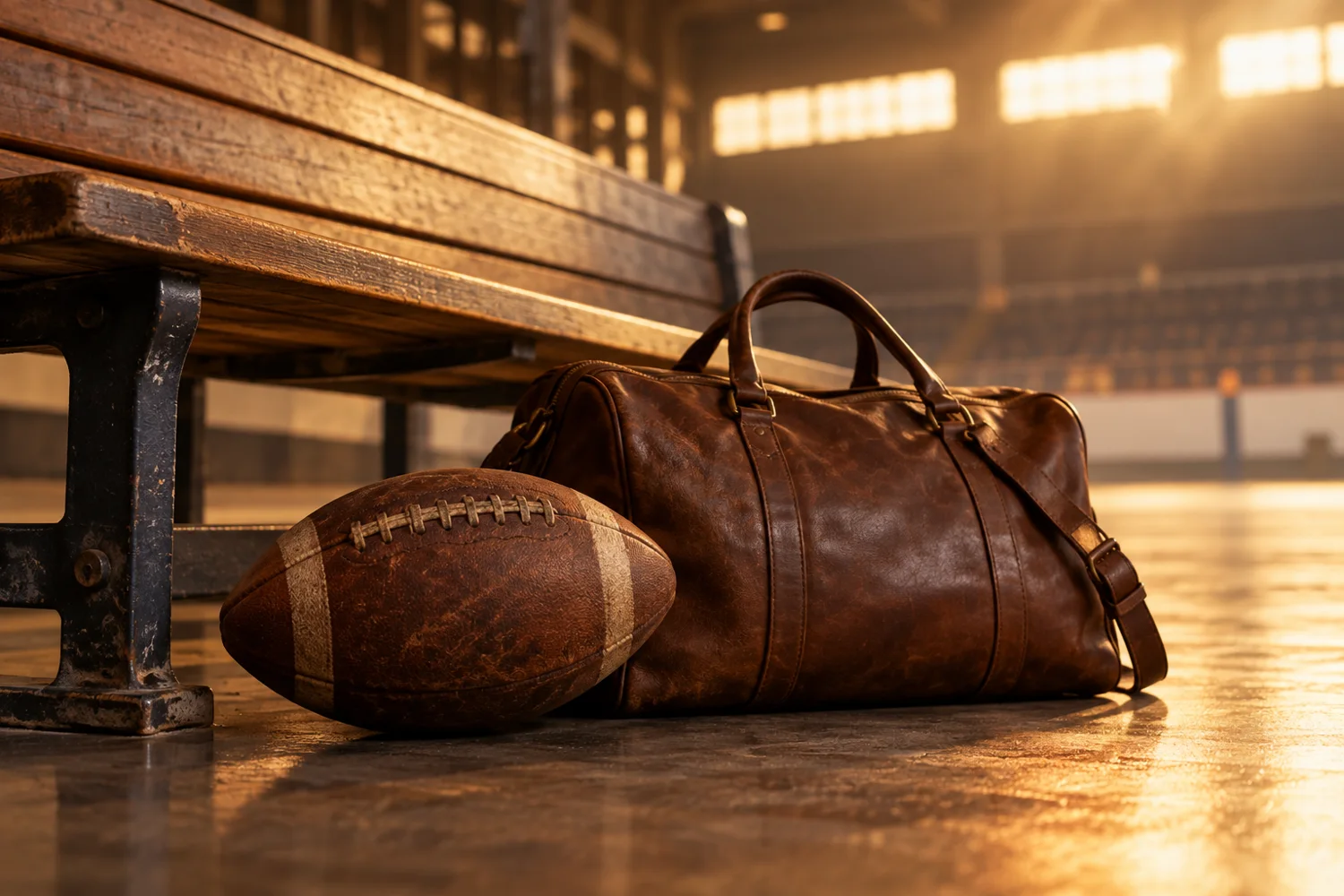
Indoor football adapts American football to an arena-sized playing surface. The familiar goals remain: move the ball, earn first downs and score while stopping the opponent. The smaller space changes how quickly a play develops. Exact rules depend on the league and season, so this guide explains the format rather than presenting a current official rulebook.
A compact version of the gridiron game
A common indoor format uses eight players per side on a field roughly 50 yards long between the goal lines. End-zone arrangements and usable width depend on the competition and building. Those dimensions make the field feel immediate: a short gain outdoors can take up a much larger share of the indoor playing area.
The relevant comparison is with the playing field, not the entire arena floor. An arena also needs room for benches, equipment, access routes and the spectator boundary. When watching a replay, look for the painted field and the padded perimeter before judging a route or a tackle.
A roof alone does not make a game indoor football in this sense. An NFL game in an enclosed stadium remains the full-field outdoor-code sport. Here, indoor identifies a smaller-field football format with its own competitive rules.
Downs and field position
The offense receives a series of downs to gain the required distance. The defense tries to stop that advance or take possession. A new viewer can follow the game by tracking three things before the snap: the down, the distance and the spot of the ball.
Because the field is shorter, the offense can threaten the end zone from locations that look far away on a television shot. That does not mean every pass should go deep. A completion that creates a manageable next down can be more useful than a spectacular but low-percentage attempt.
Do not assume every fourth-down option works exactly as it does in the NFL. Indoor competitions can restrict or eliminate punting and treat missed kicks differently. An old broadcast may also use rules that have since changed. A commentator’s explanation belongs to that game’s rule set.
The snap and the passing game
The center starts the play by delivering the ball to the quarterback. Receivers use their releases and routes to create throwing windows; blockers protect the passer within the allowed alignment. Defenders read those movements while keeping responsibility for their assigned space or opponent.
The short field compresses timing. A quarterback may need to release the ball before a receiver appears open to the camera. The receiver’s landmark and the quarterback’s expectation must match. A late throw can arrive after a defender has closed the same window.
This is an observation guide, not a claim that every indoor offense uses the same scheme. The useful question is what a team asks each player to accomplish. Watch whether routes clear space for one another, whether protection holds long enough and whether the passer has a safe answer when pressure arrives.
Motion before the snap
Some indoor formats allow a receiver to approach the line at speed before the ball is snapped. The permitted number of moving players, direction of motion and timing are league-specific. Treat motion as something to identify in the relevant rules rather than as permission for every player to run forward.
For the viewer, motion creates a useful visual cue. Follow the moving receiver first, then check how the defense responds. A defender may travel with the receiver, exchange responsibility with a teammate or preserve a zone. Each response changes the picture the quarterback sees.
A receiver crossing too early can also draw a penalty. If a play stops before the pass, check the flag and the official’s explanation. Do not assume the whistle means a foul occurred during contact with the ball carrier.
Boundaries and the arena environment
Padded boards place a clear edge around much of an indoor field. Their presence changes the space available to runners and receivers. Players cannot count on the same broad sideline area found at a large outdoor stadium.
The boards are not an invitation to treat contact as unregulated. Legal tackles, dead-ball situations and player protection still depend on the rulebook and officials. When reviewing a collision, separate the point at which the play ended from the contact that followed.
Spectators are close, but the playing surface remains a controlled area. A ball entering the stands is a different issue from a ball touching a permitted rebound surface. Arena architecture should never be used as a substitute for the competition’s written definition of a live ball.
Indoor football and rebound nets
The original Arena Football League’s game system used rebound nets near the goalposts. Those nets are a distinctive historical feature, not a universal requirement of all indoor football. Reading’s league history should not be described by copying every feature of a different competition.
A viewer can often spot the difference immediately by looking behind the end zone. Even then, appearance is only the beginning. Whether a particular ball remains live depends on how it arrived there and on the applicable rules.
This is one reason broad phrases such as arena rules can be misleading. Identify the league, the season and the rulebook before explaining an unusual kick or reception.
Scoring and the clock
Touchdowns, conversion attempts, field goals and safeties are familiar scoring categories. Special kicking bonuses or unusual point values require separate confirmation. Avoid carrying a rule remembered from one indoor league into another without checking.
The same caution applies to clock stoppages. End-of-half procedures can change tactics, and a team’s apparent urgency may reflect a rule the broadcast has not yet explained. The scoreboard tells you time remaining; the rulebook tells you how quickly that time can disappear.
To understand a close finish, track possession, timeouts and the next likely clock event together. A quick score can leave the opponent another chance. A longer possession can reduce that chance but also increase the risk of ending without points.
A simple viewing routine
Before each play, read the scoreboard. Find the ball, identify the moving receiver if there is one, and watch the first second of protection. Then follow the pass or run. After the whistle, check the spot and any penalty before interpreting the next down.
For historical games, record the league and date alongside your notes. This small habit keeps a useful tactical observation from becoming a mistaken universal rule. The goal is to recognize what the game is asking the players to do, then enjoy how quickly they solve it.
Continue exploring: Indoor vs. Outdoor Football or return to the Reading Express chronology.
Sources & editorial context
Published as a new historical or interpretive article in 2026. How we handle evidence and corrections.